Ship at the speed of AI.
Keep production safe.
The open-source release platform that scores every change, verifies every rollout, and rolls back when a regression hits.
DEPLOYMENT OVERVIEW
Every release. Under control.
Works with the stack you already run
 Kubernetes
- Argo Rollouts
 Amazon ECSbeta
 Prometheus
 Datadog
 GitHub Actions
 Slack
Slack Go + TS SDKs
The missing step in your pipeline
More velocity.
Less crossed fingers.
Your tests check the code. Alror checks the release.
One continuous safety net, from merge to production.
Understand the change.
A risk score with a reason behind every point. Know what changed and what deserves a closer look.
Explore risk scoringRelease at the right pace.
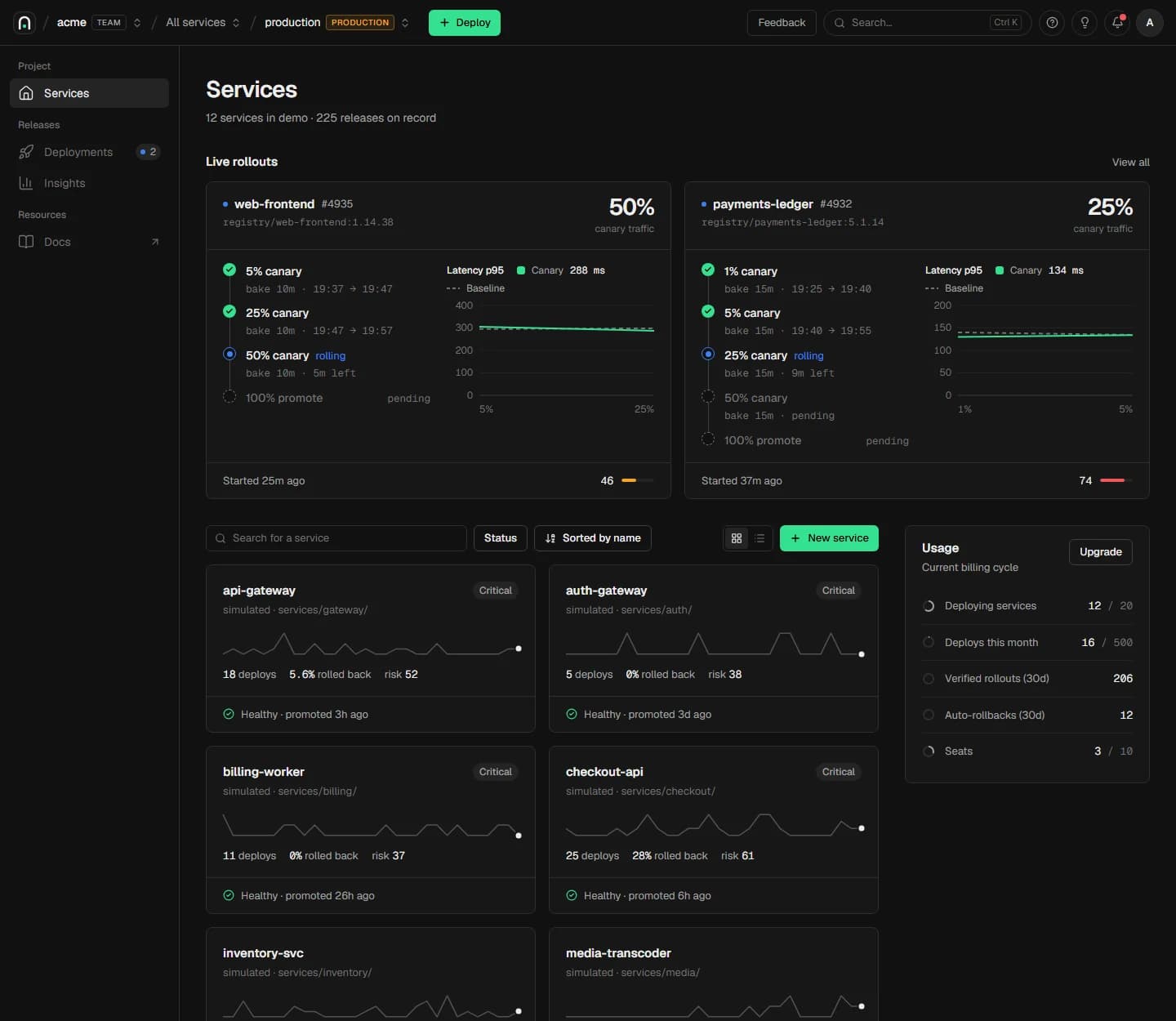
Small changes move fast. Risky changes take smaller steps, with live metrics checking every stage.
See progressive deliveryRecover automatically.
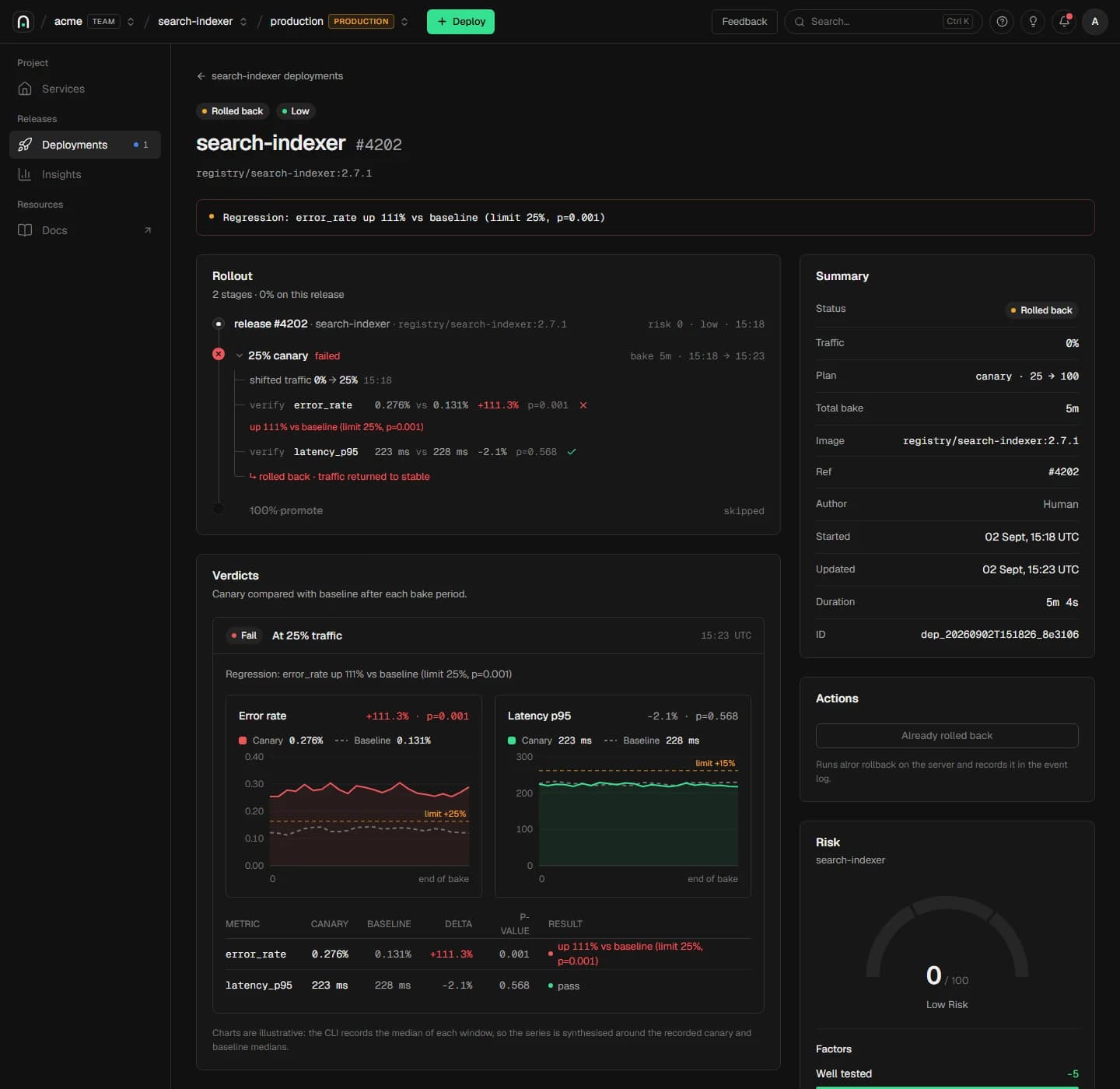
When the canary regresses, traffic returns to the baseline. You get the evidence behind the decision.
Watch a rollbackChange intelligence
Every change has a story.Know it before you ship.
Turn a diff into a clear, auditable risk score. Critical paths, missing tests, recent rollbacks: see what matters and how it shapes your release. Try it below.
What if
1 files+98 −22
- services/checkout/payment/retry.go+98 −22
Alror / change-risk · check run on #4821
checkout-api
0/100Risk score 62 out of 100, medium risk.
medium risk
| Pts | Factor | Detail |
|---|---|---|
| +12 | Critical servicecheckout-api is marked critical | checkout-api is marked critical |
| +12 | Recent rollbacks2 rollbacks on these services in 30 days | 2 rollbacks on these services in 30 days |
| +10 | Sensitive pathschanges in payment | changes in payment |
| +10 | No tests changed1 code files, 0 test files | 1 code files, 0 test files |
| +10 | AI-authoredcommit authors or trailers indicate a coding agent | commit authors or trailers indicate a coding agent |
| +8 | Small diff120 lines changed | 120 lines changed |
Rollout plan
- 5%
- 25%
- 50%
- 100%
canary · 4 steps · 30m of bake time · 10m bake per step
With --fail-above 85 the check becomes a merge gate. This change passes.
Progressive delivery
Confidence at every step.A way back, built in.
Compare your canary with the baseline on real error rates and latency. Watch a healthy release progress, or see a regression caught at just 5% of traffic.
- 5%bake 10min progress
- 25%bake 10mpending
- 50%bake 10mpending
- 100%promotepending
| Stage | Metric | Canary | Baseline | Δ | p | Result |
|---|
Developer first
The engine is a CLI.At home in your pipeline.
Risk scoring, rollouts, verification and rollback all run inside one Go binary, usually as a single CI step. The output is built for humans, and the exit codes are built for CI.
$ curl -fsSL https://raw.githubusercontent.com/alrors/alror/main/scripts/install.sh | sh- License
- Apache-2.0
- Runtime
- Single Go binary
- SDKs
- Go · TypeScript
- Exit codes
- 2 rolled back · 3 gate
$
Fits your workflow
A safer pipeline.Not a new pipeline.
Keep your CI, your registry, and your cluster. Add a check to your pull requests and one step to your deploy job. You're on your way.
Step 01
Install the CLI and initialise
One binary.
alror initwrites alror.yaml and a .alror/ folder. Try it with no infrastructure: the default target and metrics are simulated.Terminal$ curl -fsSL https://raw.githubusercontent.com/alrors/alror/main/scripts/install.sh | sh$ cd path/to/your/repo$ alror init # alror.yaml + .alror/$ alror risk # score your current change$ alror deploy -s checkout-api -i registry/checkout:1.43 --regress error_rate=1.8 # watch a rollbackStep 02
Score every pull request
The check action posts an Alror / change-risk check run and one sticky comment with the score, the factors and the rollout plan. Set fail-above to turn it into a merge gate.
.github/workflows/alror.ymljobs:risk:if: github.event_name == 'pull_request'runs-on: ubuntu-latestpermissions:contents: readchecks: write # the "Alror / change-risk" check runpull-requests: write # the sticky risk commentsteps:- uses: actions/checkout@v4with:fetch-depth: 0- uses: alrors/alror/actions/check@mainwith:comment: "true"fail-above: "85" # block very risky PRsStep 03
Deploy through the gate
Keep your build. Replace the deploy command with one step. The score picks the plan, and a rolled-back release fails the job, so the bad release is visible.
.github/workflows/alror.ymldeploy:if: github.event_name == 'push'runs-on: ubuntu-lateststeps:- uses: actions/checkout@v4with:fetch-depth: 0# … build and push your image here …- uses: alrors/alror/actions/deploy@mainid: alrorwith:service: checkout-apiimage: registry.example.com/checkout-api:${{ github.sha }}shadow: "false" # "true" recommends rollbacks, never actsStep 04
Verify against your metrics
Point Alror at Prometheus or Datadog. Each stage compares canary and baseline; a regression past the limit with p below α rolls traffic back on its own.
alror.yamlservices:- name: checkout-apipaths: [services/checkout/]target: kubernetes # Argo Rollouts, or ecs (beta)critical: truemetrics:provider: prometheus # or datadogurl: http://prometheus:9090policy:max_regression:error_rate: 0.25 # +25%latency_p95: 0.15 # +15%alpha: 0.05auto_rollback: truenotify:slack_webhook: https://hooks.slack.com/services/…
The whole picture
One home for every release.Hosted on your terms.
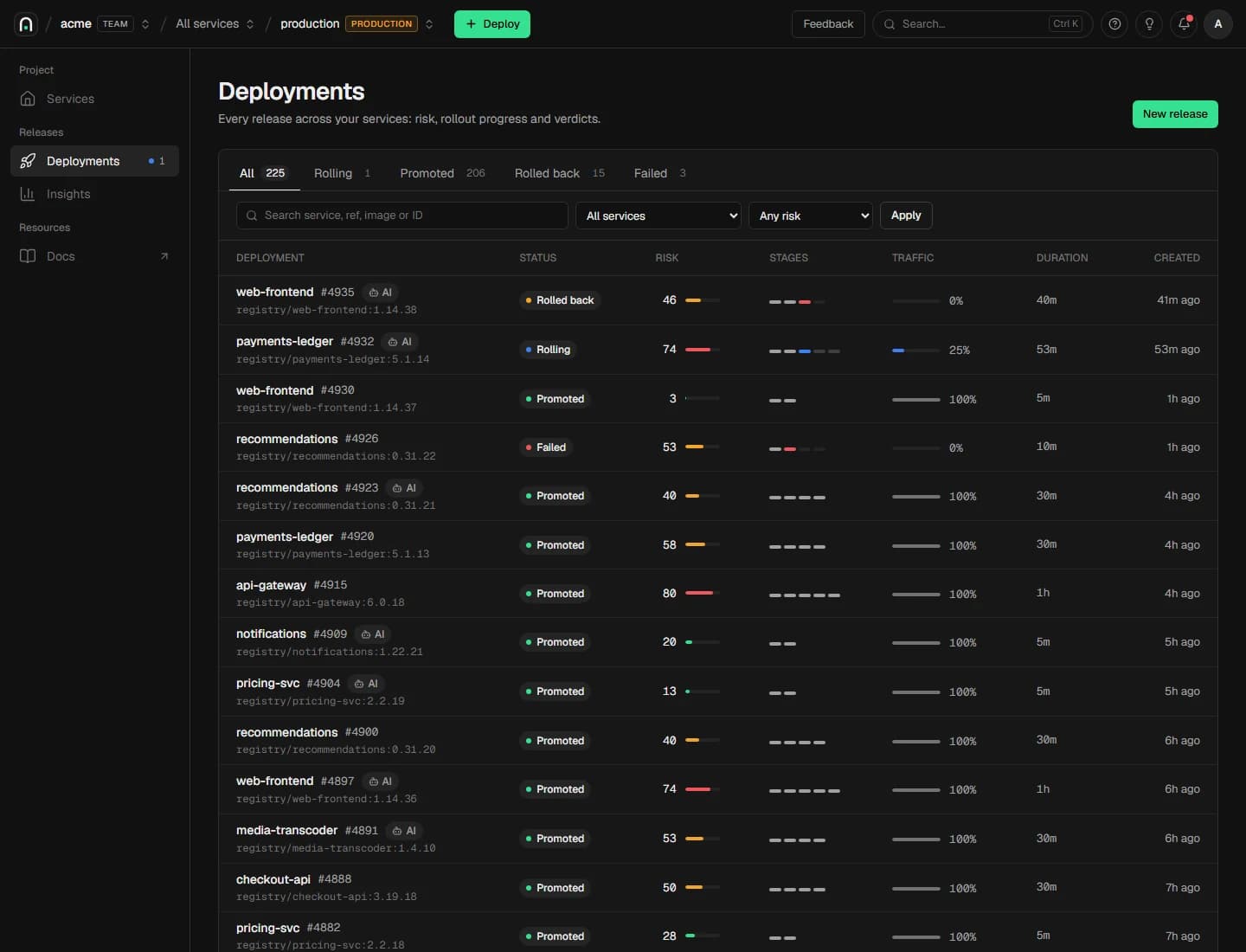
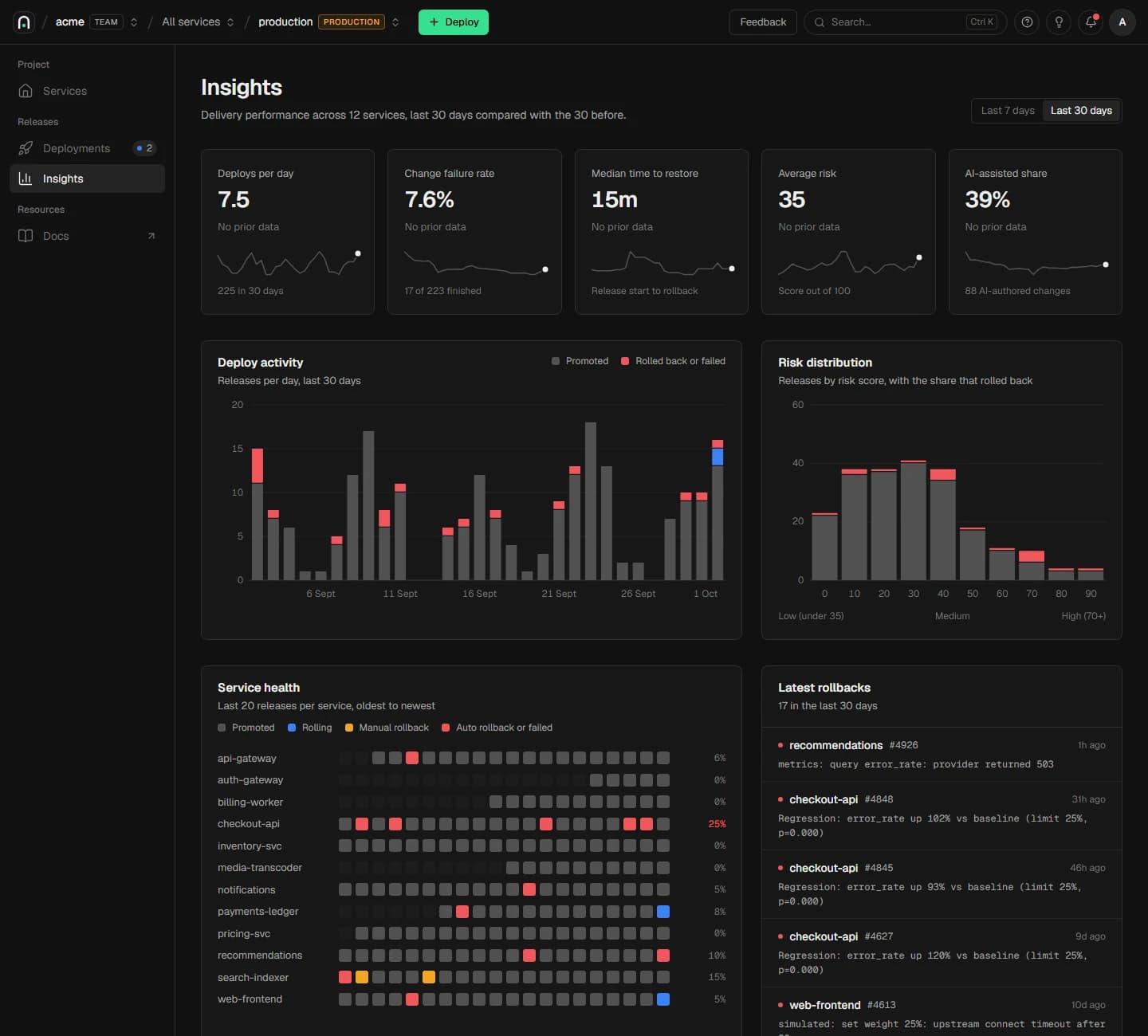
Live rollouts, shared policies, and the story behind every deployment. Connect the CLI to your self-hosted workspace and bring your team into the loop.
Every release across your services: risk, rollout progress and verdicts.
Built in the open
Your infrastructure.
Your platform.
Release safety should be something you can inspect, run, and make your own. Alror is open source, from the CLI to the console. Read the code. Shape what comes next.
A few things to know
Good questions.
Straight answers.
Dig into the details, or start a conversation with the project.
Join the discussionDo I have to replace my CI?
No. Alror runs as a step after your build. On GitHub Actions, use the check and deploy actions; anywhere else, run the alror binary. Your build, tests, and registry stay as they are.
How is the risk score calculated?
Alror reads the diff against your base branch: change size, affected services, critical services, sensitive paths, test coverage changes, AI authorship, and recent rollbacks. Every point is listed with its reason. You can inspect the rules and tune your policy.
What makes a rollout roll back?
A stage fails when the canary exceeds your per-metric regression limit and the Mann-Whitney test agrees. Alror compares error rate and latency against the baseline. Start in shadow mode to see its decisions before enabling automatic rollback.
Which platforms are supported?
Kubernetes through Argo Rollouts, and Amazon ECS in beta. Verification reads Prometheus or Datadog, and notifications go to Slack. GitHub Actions integrates directly; other CI systems can run the CLI.
Does my code or data leave my environment?
In local mode, nothing phones home: state is stored as JSON under .alror/. In connected mode, the CLI writes deployment events to your self-hosted workspace. Metrics are queried from your network by the CLI or runner.
What can I self-host?
The CLI, workspace console, and runner are part of the open-source platform. Run the CLI on its own or host a workspace for shared policies, deployment history, API keys, and an audit log. The repository includes Docker setup instructions.
Your next release.
A little more fearless.
Start with a single change. Build confidence from there.